How to Improve Your Atlas Stone Performance: Takeaway Points
- Atlas stone performance is a huge predictor of strongman/woman performance
- Your final placing can come down to your performance in this one event
- 10 immediately actionable tips to improve your atlas stone performance
10 Tips for Improving Atlas Stone Performance
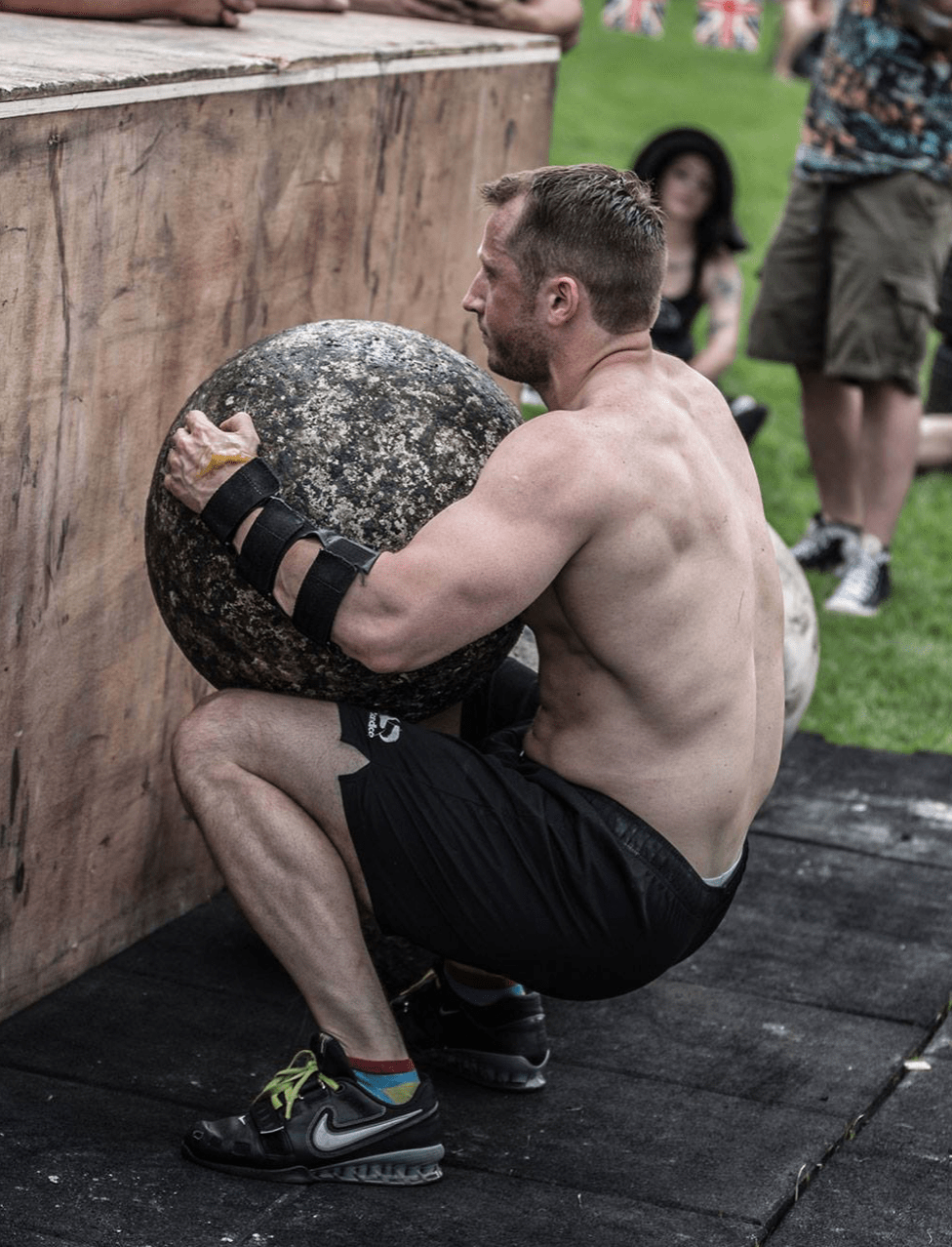
The atlas stones are synonymous with strongman. They are a timeless classic. With their usual position as the grand finale of World’s Strongest Man time and again, they produce quite the spectacle. Many a competition and World Champion has been decided on the final atlas stone run.
They are one of my big 5 when it comes to predicting strongman/woman excellence. This means they are of huge importance if you want to do well in this sport. Picking heavy and awkward objects off the floor and loading them will be something you must perfect to reach the higher echelons of the sport.
If you want to improve your atlas stone performance, here are my 10 top tips to ensure you excel at your next event.
1. You must be strong AND fast
Success leaves clues – and if you look at who is currently the best at the atlas stones (Nov 2020) Tom Stoltman, he is not only the quickest, but he also holds the world record for the maximum in this discipline. Strength is the mother of all qualities and creating a larger base for strength will help provide the platform for speed, but speed also needs to be trained as a separate entity.
If you look at the force-time curve, it is not a case of just training heavy but also training speed strength. Speed strength will be best improved at lower intensities, or percentage of maximum. I prefer to review the velocity or speed of the load and not recommend percentages as that is more important as some can use 60% of maximum and are still slow.
Therefore, I would recommend structuring your training to allow the improvement of both strength qualities or velocities. Train speed for 2-3 weeks and then train maximal strength for 2-3 weeks.
2. One motions are the difference maker
Context: a one motion is defined as a stone load with no countermovement.
When you review head to heads in strongman on the atlas stones – if athlete A performs the first 4 stones with a one motion, but athlete B performs only the first 3 stones with the one motion, that athlete A is in a better position to win the event. In other words, if you are not training to improve the speed and strength of your one motions, then you are doing yourself a disservice.
Considering the first recommendation of training to improve speed or strength, you are left with an easy way of periodising these into your training:
- 2-3 weeks of speed strength, one motion technique
- 2-3 weeks of maximal strength, lap & load technique
3. Identify your weak link and plan accordingly to improve it
Any lift can be broken down its parts to improve it and the atlas stones is no different. Most athletes will fail the lift at the initial pick up from the floor, or the load which is the top range of motion. The strength off the floor requires powerful hip extensors and the strength of the load requires strong back extensors.
Recommendations based on your weak points
If you lack strength off the floor, or fail the initial pick up at heavier weights, improve your hip extensor strength with Romanian deadlifts, standing good mornings or even semi-sumo deadlifts. These lifts train the musculature and strength curve to improve this specific weakness. Semi-sumo deadlift is simply a sumo deadlift with a narrower stance. Think Ed Coan stance width, as opposed to the lifters that get their feet near enough touching the plates.
If you lack strength on the load, or the top part of the movement, improve your back extensor strength with flat back extension, glute ham raises and reverse hypers.
4. Condition the body for rounded back strength
It is impossible to pick up the atlas stone weights given in competition with a neutral spine. You can lift extremely light stones this way, but you will not go far in the sport.
The first key to rounded back safety is bracing ability – how much intra-abdominal pressure you can create will safeguard your spine from exploding out of your rear end.
The next step is to train it. For example, I promote the rounded back sled pull through as the first exercise, as it is concentric only and a safe way of easing someone in to rounded back work. After that, I move clients to flat and incline back extensions where you can also perform rounded back work but with the bonus of eccentric contractions, to further improve hypertrophy.
5. Get creative with progressive overload
One of the problems with training atlas stones is the lack of micro-progression with weights. My first set went from 105kg to 120kg to 135kg and all the way to 160kg.
Every problem though is an opportunity to find a solution! As a coach, it is quite refreshing to needing to find alternatives instead of simply adding a small amount of weight to the barbell. Here are some options:
- Train the same weight to a higher platform
- Use complexes: for example, 1 x deadlift then return to floor and then lap & load
- Use pauses at different points within the movement
- Pre-fatigue the stone lift
- Improve the speed/time at which you can load a stone for multiple repetitions
- Lift the same weight but a higher total of repetitions
- Train the same weight but a larger amount of sets
- Use the same weight but reduce the rest period
6. Train them fatigued closer to competition
The atlas stones being the last event is usually a function of tacky removal issues! Anyone that has used tacky knows that it is not the easiest substance to get off. Placing it last allows the competition organiser to get the scores and placings in order whilst the athletes are messing about with baby oil and/or white spirit!
Therefore, as you approach a competition, it is a good idea to apply the law of specificity and train them in a similar state you will be, come the competition. It does not mean you have to perform all the competition events beforehand but mimicking which muscles might be fatigued and by what contraction type will allow you to experience what is going to happen and adjust based on this.
7. Invest in stone sleeves
When I first trained atlas stones back in 2008, the bruises that were left on my forearms were tender to touch for probably a week. I did not learn my lesson, as I did not invest in stone sleeves until 2016 and often, the anxiety of how my arms were going to feel the day after training them, hampered my progression.
If you have a set of stone sleeves this negates this problem and will allow you to train them week in, week out.
One downside to stone sleeves is that they can be prone to slipping, especially in hot weather. However, this can be attacked with some extra duct tape around the elbow.
Regardless, you do not have to use them for competition, but I highly recommend investing in a set to use for training as they permit a higher volume and quality of work which transfer positively to competition.
8. Use predictor lifts to overcome plateaus
The 3 key predictor lifts for atlas stone performance would be individualised to each portion of the movement.
For the initial deadlift from the floor, we would use the semi-sumo deadlift. With the movement from the lap towards the top of the load, we would would use the front squat. The very end range of the movement would be the flat back extension with a barbell on the traps, as a maximal isometric hold.
Therefore, it’s essential to know where you are with these 3 lifts. If performance is stalling with your atlas stones, then take time to add kilos to one or more of these lifts and then go back to training the stones.
9. Time your sets
I harp on about the use of a stopwatch in the sport of strongman/woman often. Your personal bests should also have a time added to them. It could be that you know how quickly you load 3-5 incremental stones to your platforms or one stone for multiple repetitions.
At the end of the day, strongman/woman is a timed event and your progress should be determined by this key variable.
10. Visit other gyms
Strongman/woman is not a standardised sport by any means. There are many atlas stone manufacturers out there all with different dimensions. I have got a 150kg stone that feels heavier, or harder to load than my 160kg. Similarly, UK’s Strongest Man stones, although are lighter on paper, are huge in diameter also.
It’s therefore recommended you utilise visiting different gyms wherever possible and try different atlas stones.
This approach will prepare you for most eventualities, especially if you are unable to visit and utilise the set that are going to be used in competition. I know many a champion strongman that will travel or invest in the same equipment they are going to compete on, so they minimise the chance of surprises. Attention to details is rarely a bad thing!
We have various atlas stones at our facility, Winning Strength Southampton, available to try.
Conclusion
To conclude, I cannot say enough that improving your performance in the atlas stones will have a huge return on your overall strongman/woman performance. It is one of the big 5 along with the log, deadlift, back squat, and yoke.
Applying the ten tips above will ensure continual progress in this hugely important event. If you hit a plateau with your atlas stone training then return to this article and apply the appropriate tip to continue your development!
Article written by: Tom Hibbert
Published on: 08/04/2021