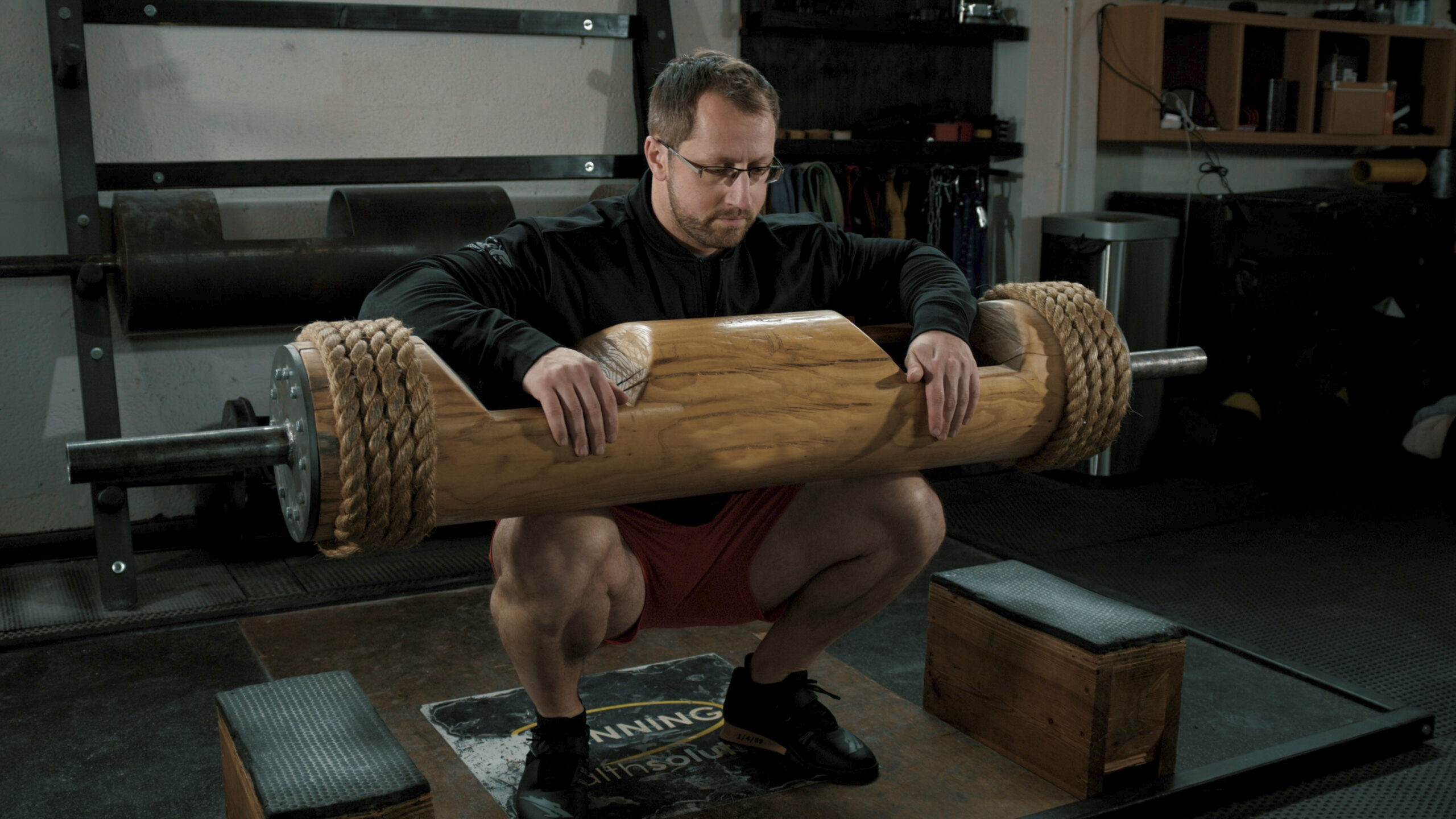
How to Improve Your Log Clean
I get many messages or comments on how effortless my log clean is. This is by design because the easier the clean, the more energy I have left for the press. If you are grinding out a clean there is something seriously wrong. It is so painful for me to watch some clean slowly! A clean should be smooth and crisp.
I personally have never really struggled with the clean, but I have had countless clients that have. From an inability to clean weights, they know they can press to biceps injuries; I have seen many different case studies and used the below tips to correct the issue at hand.
By applying the below 10 tips I am sure your clean performance will improve drastically which then transfers to higher clean & press numbers which is obviously a passion of mine!
1. Flat back extensions
If you want to apply force all the way through the strength curve you best have some back extensions in your program!
This is the first tip because it is the most important. Too often, strongman programs lack this important movement pattern.
Back extensions stimulate the end range of the movement which is a dead area for tension in the clean. Simply put, improving strength in the back extensions allows you to apply force from bottom to top more readily.
Flat back extension, incline back extension, reverse hyper, glute ham raise, inverse curl and standing good morning machines are all valid and great options. If you do not have access to any, there is no work around, so I am not going to offer alternatives. You can get creative with makeshift back extensions, but you cannot swap them out for things such as Romanian deadlifts or good mornings as it is the opposite strength curve.
The added benefit of the back extensions is spinal traction over spinal compression, another important variable to consider when designing strength training programs.
2. Power clean warmups
Adding power clean variations to the warmup sets of your log clean and press days is a very time efficient way of improving speed and power output. Strength and speed are two separate qualities and must be trained accordingly. The ability to recruit your highest threshold motor units and fast is a problem I see very often.
There are many different variations you can opt for here: from hang or from blocks and both can be set at different heights, paused on eccentric, paused on concentric, concentric only or eccentrically controlled. If you want to get creative for a set goal you could even mix/combine the options.
If your clean is on the slow side with maximal weights use this approach as it works wonders. I like to recommend the client warm up to a specific weight or to simply stop when the speed slows down. If the client has had optimal recovery and is feeling good though, they can attack it and set a personal best.
3. Selecting weight based on speed
Just because you can lift it, does not mean you should!
Read that again as it applies to all your lifts and not just the clean. I like to select weights based on speed, technique, and effort and I rarely prescribe percentages. If you want to lift faster, you need to perfect lifting fast!
What I have found is you can become neurologically wired to lift at a certain speed for an exercise. As per my introduction the clean needs to be effortless. If you are cleaning the log slowly then there is absolutely no way, it is going to be effortless. So, select weights based on the speed of the clean and not what you can press overhead. Your clean will soon catch up and reach your pressing weights.
4. Triple extension
Using the power generated by 3 joints is going to be stronger and efficient than 2 joints. Sounds obvious but too many athletes do not get through their toes/ankles. I even see strongman who do not get through their toes/ankles on the push press! The common response is they have knee issues…well, fix the bloody knee issue, this isn’t rocket science.
Anyway, the fix for this could be a cue or it could be as simple as filming your feet and reviewing. Pay attention to them during the warmups. If you are not executing it during light weights, it will not magically fix itself when you increase the weight.
5. Banded cleans
Adding bands to the log and performing cleans will change the strength curve of the movement. It will also increase the velocity at which you will need to perform the movement. Increased velocity requirements equate to an increased effort from you, the athlete. Effort determines motor unit recruitment. Therefore, the bands will make you recruit higher threshold motor units which is conducive to increasing strength and power.
I would recommend performing these for speed strength as per point 3. We want to perform fast cleans and maximal effort attempts will be too slow to benefit performance optimally. Here’s a 4-phase repetition & set scheme you could use with each phase lasting 2-3 weeks:
- Accumulation 1: 6 sets of 6 repetitions
- Intensification 1: 8 sets of 3 repetitions
- Accumulation 2: 5 sets of 5 repetitions
- Intensification 2: 10 sets of 2 repetitions
6. Separate the press & clean
On your upper day, perform the push press from the rack, meaning no clean. On the lower day perform the clean as the first primary movement in the session, then your squats &/or deadlifts and lastly the assistance work. Do this for 8-12 weeks and then put them back together to see the improvements made.
This will allow a higher level of effort and focus solely on the clean, and will translate into higher weights used and technical improvements. I would also add that as the lower session is a higher priority it would be best to do this when freshest. Often the first session of the week is conducive to this as the weekend usually brings relaxation away from work duties, but this will be individualised.
7. Fully extend on deadlift phase
Positioning at the end of the deadlift phase of the log can determine quality and efficiency of the clean in the next phase. If you are leaning forward when you bend down into the squat as you ready for the clean, your torso has further to travel to finish the clean.
Your glutes are also in a disadvantageous position as you must extend back with erector spinae first then glutes can come through. A strong position is to be bolt upright as you descend into the squat for what is a coil for the clean, and already have the erector spinae locked out giving the glutes the optimal positioning to fire.
8. Release hip flexors
Tight hip flexors will inhibit the amount of force the glutes can produce. If the hip flexors are presenting as tight then the glutes, then present as lengthened. If the glutes are lengthened, they will also show as weak. Tight hip flexors will also limit the range of motion you can achieve in triple extension further reducing the amount of force you can produce during the clean.
You can release the hip flexors with some soft tissue work, dry needling or even a massage gun and you can do this before or even in between sets on the log clean. Some PNF stretching might also be indicated and beneficial at the same time as the soft tissue release.
9. Include Plyometrics
Plyometrics recruit the posterior chain as the prime mover which is the same as the clean. Plyometrics will also recruit triple extension which gives you strongmen further exposure on getting your damn heels to come off the floor!
They are explosive by nature and always quick. They are your first gear. Improving the first gear allows you to learn to accelerate quicker. Remember I mentioned that a big issue is speed, and nothing is going to be faster in execution than plyometrics that target the improvement of rate of force development.
10. End Range Brachialis Strength
At the end of a log clean, the brachialis will be recruited as you approach the end position of the log on your chest. If the log clean was too slow due to a technical issue, then strengthening the following movements would also act as insurance to ensure you are strong enough to finish the movement.
To target this, your best movement is prone curls with a semi-supinated or pronated grip – they are often referred to as spider curls. The semi-supinated or pronated grip reduce the amount of tension the biceps brachii can produce and tension switches more to the brachialis.
I recommend using dumbells, or EZ bars and switching the grip every 2-3 weeks. The brachialis responds very well to slow tempos and eccentric or concentric pauses. It is also fast twitch so reducing repetitions from 3-6 would give you the best return on time invested.
Conclusion
There is nothing more frustrating that knowing you can press a certain weight, but you are unable to clean it!
Do not be this person. Add the above tips in to your training slowly but surely with the knowledge than improvements and new personal bests are around the corner. Many of these tips will have a knock on effect to other movements if you train for strongman/woman and are readily applicable to any type of clean, whether it be a barbell, axle or dumbbell.
2 comments
Lars Besand
June 15, 2021 at 6:12 pm
Really like This – very informative and helpful!
Thomas Hibbert
June 16, 2021 at 4:58 am
Thank you, appreciate the support!