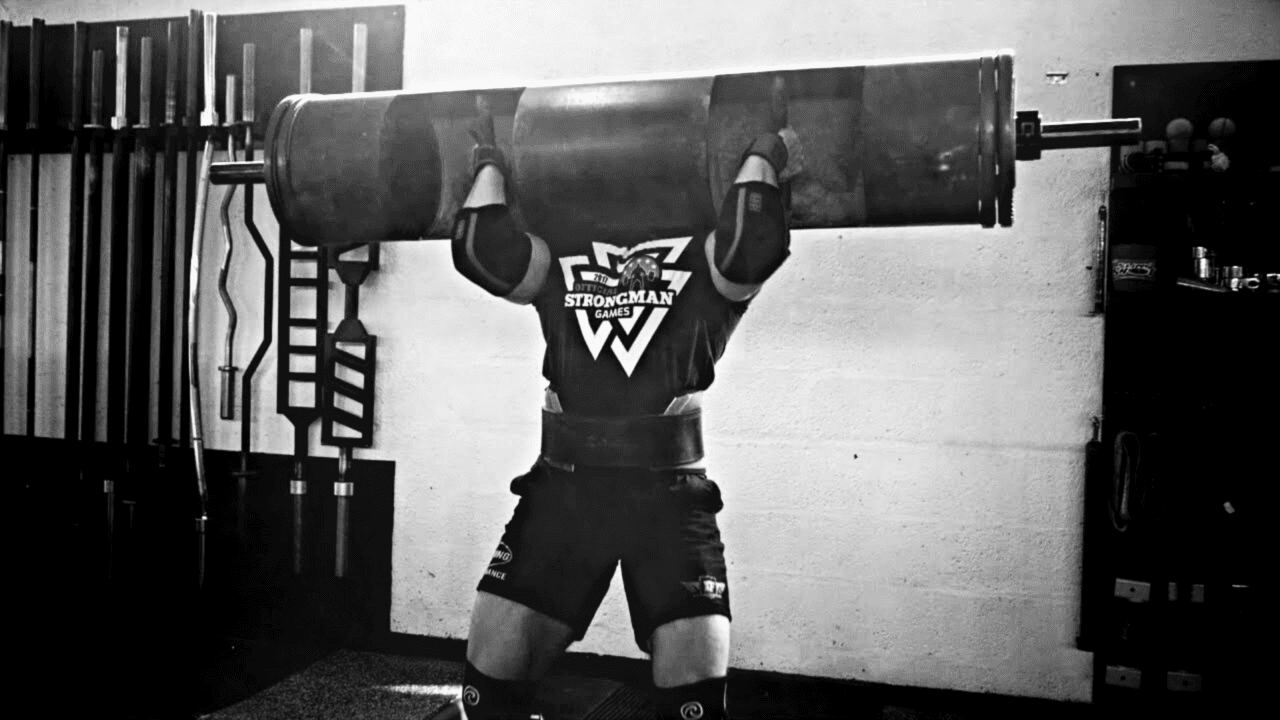
Why is having a great rack important for push press?
The rack position is where the log is resting on your upper chest or clavicle area and optimal positioning here is key if you want to perform the biggest push press possible.
The dip phase is ideally short, sharp, and violent but when the rack is not set right then transfer of power from the legs into the log just will not happen.
I see many lost kilos due to a poor rack.
A tell-tale sign is movement of the log. I tend to watch the handles and/or elbows. If the elbows drop, the handles will roll forward. A forward inertia of the log during the eccentric of the dip phase means the same inertia will carry into the concentric phase of the dip/leg drive. If the log travels even 1mm forward, it is like adding kilos to the weight of the log due to the lever now being longer. This results in failed lifts. A tell of this happening is often a sticking point at the lockout.
As is always the case, there can be several reasons that are causing this inefficiency. A good coach will be able to pinpoint the ones you specifically will need to work on, but here is an extensive list so you can apply them to yourself.
How to achieve log push press mastery
1. Ensure you have adequate mobility
Long gone should be the notion that strongman is a sport full of overweight immobile bodies. It is correct that many strongmen have incredible amounts of musculature on their frame. It should not stop you, or them, from achieving optimal mobility standards or at least striving to improve if they fall short.
I often talk about the handbrake being on when people overhead press. If you have issues in the following areas this could be the case for you. You may have the strength, but you are unable to truly express it due to tightness. Remove the tightness and then suddenly, your lifts take off!
-
Latissimus dorsi (lat)
Assess by raising your arm locked at the elbow with a supinated hand position. If your arm/hand twists before your biceps reaches your ear, then you have some work to do. To fix employ eccentric chin ups, doorway lat stretches and soft tissue work on the lat.
-
Upper Thoracic
Assess by performing an overhead squat and noting if you fall/lean forward. To improve your range of motion, use half kneeling windmills in your warmups, and the box PNF stretch.
-
External rotation
Assess with a standing internal and external rotation of the humerus with your arm abducted to the side. A pass is 90°of rotation either way. To improve your range, use the doorway stretch and banded arm walks.
Banded arm walks, no shrugging = too high
-
Neck extension
Assess by extending your neck which is tilting head as far back as possible. A pass is chin pointing directly upwards. The easiest fix for this is to perform neck extension movements and back extensions with an extended neck and upwards gaze.
2. Focus on your eccentric front squat
Overloading a movement eccentrically provides the motor units with double the load they are used to handling. A pure eccentric, which is performing the eccentric phase only, must be performed in a controlled tempo. This means the bar speed must be constant. You are not allowed to speed up at certain points during the range.
The limiting factor in performing the front squat is not the quadriceps, otherwise you would not be able to back squat more than you front squat. The restriction occurs due to the strength of the upper back and abdominals.
Specifically, being weak isometrically which is the exact same strength quality and identical position to the log rack position.
Once you can control 120% of your 1RM for a pure eccentric only front squat repetition at a tempo of 10-0X0, then your upper back and abdominals have adequate isometric strength for the rack position. You can indeed improve this marker above 120% but this is the minimum target I set my clients.
“If you constantly give the body the same stimulus, it has no reason to adapt.”
3. TUT at the Dip Phase
Improving the rack position from a neurological point of view will involve spending extra time under tension at this phase, whilst also offering different stimuli to adapt to. If you constantly give the body the same stimulus, it has no reason to adapt. The more comfortable you become performing slightly different protocols, the better the results you are going to see. Here are a few options.
Option 1
Something I have used with huge success is a paused dip.So instead of a reactive contraction at the knee, you bend the knees and hold for a set time. I often use 2-4 seconds with 4 seconds being the exact time at which elasticity has been shown to completely dissipate from the muscle, leaving you with a pure concentric effort. If you want to get creative have your training partner call out when to initiate the leg drive!
Option 2
Another option would be to control the dip eccentric for a set time. The dip should be short, sharp, and violent ideally, but if you are unable to harness the aggression then it’s pointless. Even though the range of motion is very small I have programmed 4 second eccentrics just for this phase before to build control and to understand the ideal range.
Option 3
A final option is to perform extra dips per push press. You could clean the log once, then perform 2-4 dips only, then on the last dip you transition into performing the leg drive into the push press.
4. Overload the Dip Phase
This sounds like the same point as we’ve just covered but when I say overload, I mean intensity. Intensity in this respect, and whenever I mention intensity, is a measure of 1RM. So, a high intensity means a high percentage of 1RM being utilised.
One of my favourites for this is heavy supports. A heavy support is where you hold a supramaximal weight at lockout. You could do this with the log or a front squat holding lifting straps for optimal transfer to the log press. The concept is inhibiting the golgi tendon reflex and make heavy weights feel normal to the body.
You can implement them several ways but two of the best would be to utilise them after your work sets have been completed as you won’t require a warmup. The second way involves pairing them with your top work sets. This would provide a potentiation effect and a subsequent increase in performance of your work sets on the log.
Obviously front squatting with straps provides an overload in intensity as it is heavier than the log, or at least should be! You can though use the front squat movement pattern to further overload the dip position. Towards a peak I like to use Isometronics for the top position as this is highest intensity possible you can provide the body. If you don’t have a power rack or the ability to perform Isometronics then simply opt for a top quarter range of motion quarter front squat. Also known as a full squat in most commercial gyms!
5. Technical excellence
This should go without saying regarding all lifts. I am still amazed as to how many believe they can move forward in the strength training with poor technique. This is those that knowingly do so. Like they are some sort of exception to the laws of physics and biomechanics!
For an optimal dip phase, you want the knees to remain over the toes. Not outside or inside them. You want the knees to only travel as far forward as if you had your toes against a wall. It’s not a squat but a stretch reflex we are after. If your knees travel too far, the stretch reflex is dissipated, and the torso can lean forward.
The optimal rack position can depend on the log being used but in general you want the upper arm to be parallel to the floor. This will mean you have to rotate the log around, so the handles are pointing in a 30-45° angle. If the log feels weightless on you this offers an ideal platform from which to thrust it into orbit. Your joints should be stacked on top of each other.
6. Inge sit up
This is an advanced assistance movement, so named after the weightlifting expert I learned it from, Inge Johansson. It is essentially a glute ham sit up with straight arms. The aim is to keep the arms perpendicular to the floor throughout.
This exercise was a favourite of weightlifters back when the Olympic press was still in competition. It works the whole anterior chain which is why it is so effective. From tibialis to quadriceps to the abdominals.
I highly recommend you ease your progression into using this movement. I know some won’t and that’s fine, but they’ll suffer with some severe muscle soreness. I thought I was ready for some myotatic pauses on this and my abs felt sore for 2 weeks! I have not experienced anything like it before.
Try using this 4x phase progression:
- Acc1: 3 x 8-10, 5010
- Int1: 4 x 6-8, 32X0
- Acc2: 3 x 6-8, 3110 (1 & Quarter)
- Int2: 4 x 4-6, 30X0
7. Blast press
The blast press is a push press from safeties. The concept is to remove the eccentric portion of the dip phase leaving you to perform the concentric only portion of the leg drive and into the push press. It is much more humbling than it sounds.
It will give you a great feedback on your eccentric utilisation. This indicates your ability to take advantage of the stretch reflex. To understand where you should be on this lift, your blast press should be 80% of your push press, and equal to your strict press. If the blast press is lower than 80%, it indicates a need for more maximal strength related training. If it is higher, then a need for more explosive related training is indicated.
As per the purpose of this article though, the blast press is also a fantastic tool to improve the rack position. It teaches you what to get tight, namely the grip and anterior chain. Without sufficient tension being created here the implement tends to go nowhere or often forward and away from lockout.
Conclusion
If you are guilty of any of these mistakes, then you are missing out on adding instant kilos to your press.
Optimal technique is something that should be embraced from your warmup weights to your maximal efforts. This will solidify technique to allow for increased efficiency. Inadequate mobility is simply a poor excuse and you just come across lazy. Action this during your early warm up sets to then recruit the new posture during the all important work sets.